

Introduction
Bioprocess development has been limited by slow experimentation, biological variability, and decisions based on retrospective analysis. Traditional approaches including, one-factor-at-a-time studies, disconnected data systems, and fixed process recipes, were designed for an era with fewer data and limited computational tools.
Today, biopharmaceutical companies face increasing pressure to accelerate development while improving productivity, process understanding, and manufacturing readiness. This shift is driving demand for technologies that enable better scale-down models, faster experimentation, predictive decision-making, and real-time process adaptation.
Recent collaborations involving Culture Biosciences® suggest these capabilities are not separate initiatives, but interconnected components of a new model for bioprocess development.
Better Scale-Down Models Drive Better Outcomes
Scale-down models are critical for evaluating process conditions and generating data needed for commercialization. However, their value depends on reliable process translation, operational flexibility, and high-quality data generation.
In a collaboration with Bionova Scientific, Culture Biosciences compared its Stratyx™ 250 bioreactor with an incumbent 250 mL platform in fed-batch CHO culture. While both systems produced comparable growth trends and product quality profiles, Stratyx delivered higher viability and productivity.
By Day 14, Stratyx achieved:
-
90.6% viability versus 78.9% under high-power conditions,
-
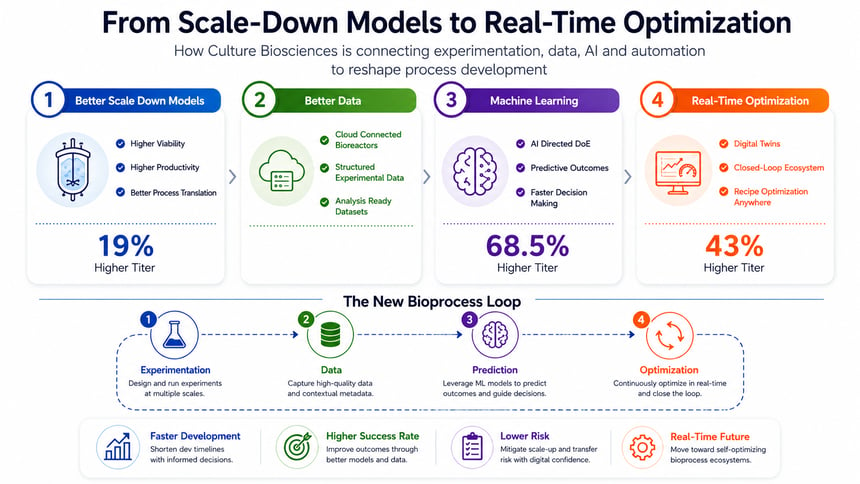
1.896 g/L titer versus 1.596 g/L (approximately 19% higher productivity), and
-
Equivalent product quality profiles.
These results demonstrate that advanced scale-down models can do more than support experimentation, they can improve confidence in scale-up decisions and accelerate development timelines.
Review the white-paper here.
Better Data Enables Better Predictions
Better scale-down models don't just improve experiments, they generate better data. And as machine learning becomes more prevalent in bioprocessing, data quality is emerging as a critical competitive advantage.
By combining cloud-connected bioreactors with tools like ChatDoE™ and DoE Analyzer running in Console, Culture helps teams design experiments, capture data, and generate insights within a connected workflow. The resulting datasets form the foundation for a future where machine learning can predict performance before experiments are run and recommend optimal process conditions with greater confidence and speed.
Machine Learning Is Improving Early Decisions
Clone selection has traditionally focused on identifying candidates that perform well under screening conditions. However, those clones may not be optimal for manufacturing environments.
Researchers at a large CDMO used machine learning models trained on routine development data generated using Culture's 250 mL bioreactors to identify alternative clone candidates that conventional approaches would likely have missed.
The top-performing clone achieved up to 68.5% higher titer compared with clones selected using traditional methods.
Machine learning shifts development from relying solely on historical success to predicting future performance.
Review Publication
From Prediction to Real-Time Optimization
Digital twins extend this concept further by enabling optimization during cultivation rather than before it begins. Because biological systems continuously evolve, static process recipes cannot adapt to changing conditions.
In a collaboration with Ark Biotech, Culture integrated adaptive digital twins with Stratyx bioreactors to enable closed-loop process optimization through continuous model retraining, real-time optimization, and direct API-based control.
The best-performing condition achieved a 43% improvement in titer compared with the historical benchmark.
Closed-loop optimization transforms process development into a system of continuous learning and autonomous improvement.
Read the white paper here
A New Operating Model for Bioprocess Development
Culture Biosciences is building capabilities that connect the entire development workflow:
Experimentation → Data → Prediction → Optimization
This integrated approach enables teams to generate better data, make more informed decisions, adapt processes in real time, and accelerate progress toward manufacturing.
Collaborations with organizations such as Bionova Scientific, Lonza, and Ark Biotech suggest that this model is helping redefine how biologics development is conducted.
Conclusion
The future of bioprocessing will rely less on disconnected experiments and static recipes, and more on intelligent systems that learn from data and adapt to biological complexity.
From enhanced scale-down performance to machine learning-driven clone selection and digital twin-enabled optimization, Culture Biosciences is helping shape the next generation of biologics development.
The question is no longer whether bioprocessing will become more data-driven and adaptive, but how quickly organizations will adopt the technologies that make that future possible.
Interested in learning more, connect with a Culture Bioscience's Bioprocess Expert.

.png?width=500&height=500&name=WhitePaper-Blog%20FI-Blue%20(1).png)
.png?width=500&height=500&name=Stratyx-Time%20Savings-HS=Blog-Tile%20(1).png)